AI Agent: The Complete Guide for Businesses
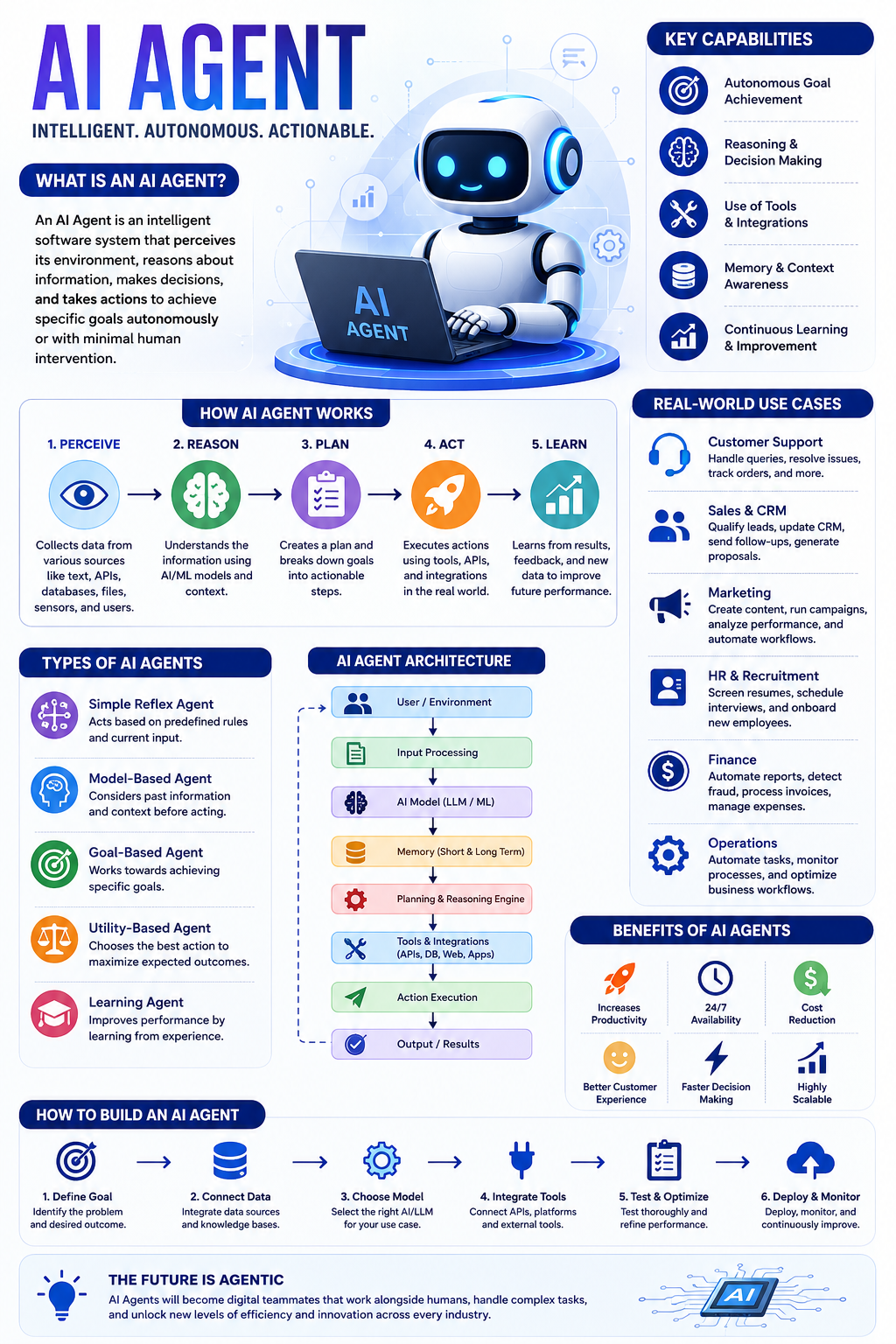
Table of Contents
ToggleWhat is an AI Agent?
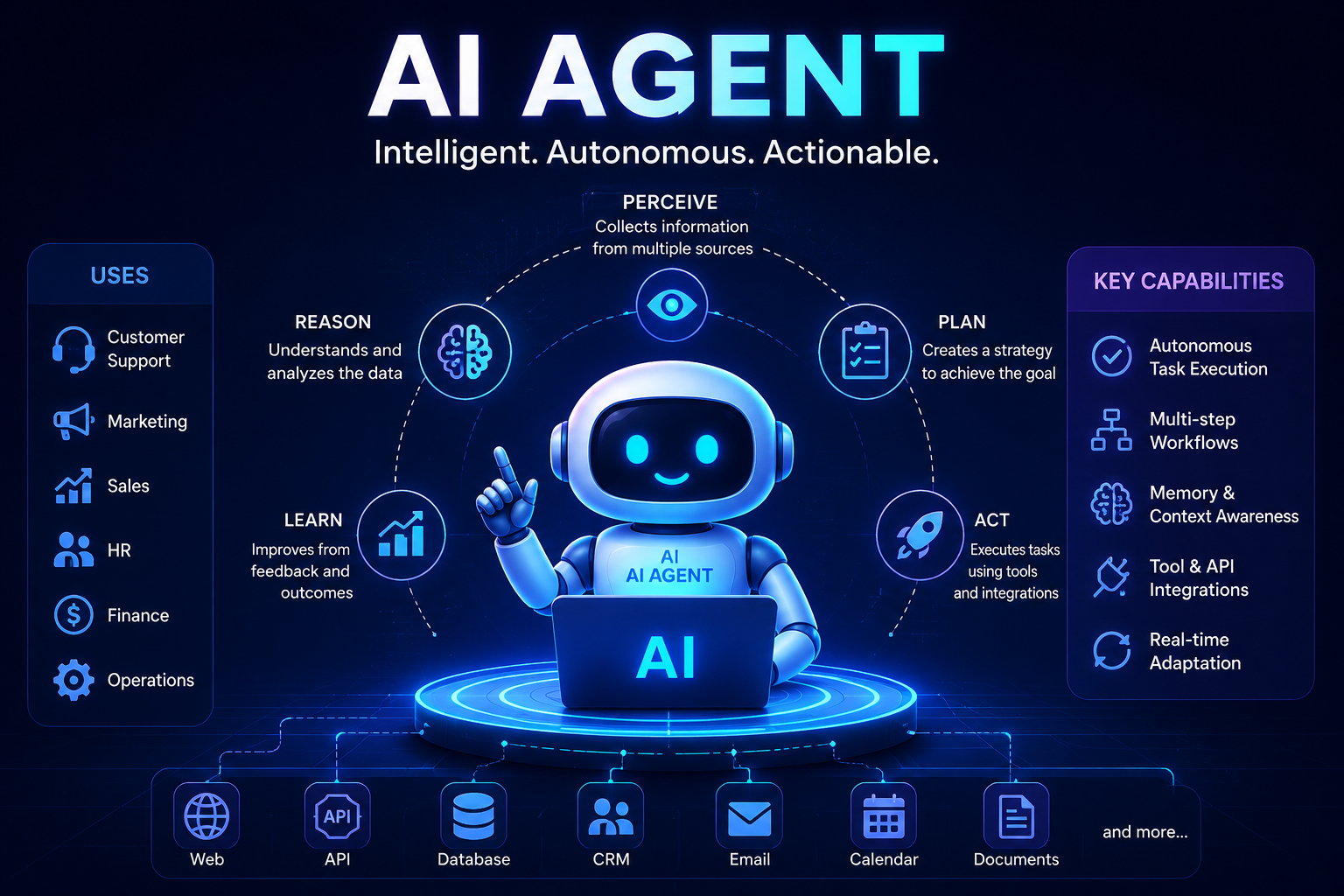
An AI Agent is an intelligent software system that can perceive information, reason about it, make decisions, and perform tasks autonomously or semi-autonomously to achieve specific goals. Unlike traditional software, AI Agents can learn from data, interact with users, use external tools, and adapt their actions based on changing conditions.
What is an AI Agent?
An AI Agent is software designed to:
- Understand user input
- Analyze information
- Make intelligent decisions
- Execute actions
- Learn from outcomes
Unlike normal automation tools that follow predefined rules, AI Agents can reason, adapt, and solve problems dynamically.
Think of an AI Agent as a digital employee capable of performing multiple tasks with minimal human intervention.
How Does an AI Agent Work?
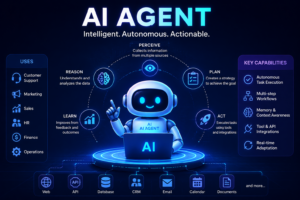
An AI Agent follows a continuous cycle:
Step 1: Perception
The agent receives information through:
- User prompts
- APIs
- Databases
- Documents
- Images
- Audio
- Sensors
Step 2: Reasoning
Using Large Language Models (LLMs), machine learning, and logical reasoning, the AI understands the task.
Example:
“Create a marketing strategy for a new clothing brand.”
The AI analyzes:
- Industry
- Target audience
- Competition
- Budget
- Marketing channels
Step 3: Planning
Instead of immediately responding, advanced AI Agents create a task plan.
Example:
- Research competitors
- Generate customer personas
- Build content calendar
- Suggest advertising budget
- Prepare campaign
Step 4: Action
The AI executes actions such as:
- Sending emails
- Creating reports
- Booking appointments
- Updating CRM
- Posting on social media
- Writing content
- Running workflows
Step 5: Learning
Modern AI Agents improve over time by analyzing:
- User feedback
- Previous outcomes
- New information
- Business data
Core Components of an AI Agent
An effective AI Agent includes:
1. Memory
Stores previous conversations and task history.
2. Planning Engine
Breaks large goals into smaller actionable tasks.
3. Reasoning Module
Determines the best solution based on available information.
4. Tool Integration
Uses external tools like:
- Google Search
- CRM
- ERP
- APIs
- Databases
5. Execution Layer
Completes assigned tasks automatically.
Types of AI Agents
1. Simple Reflex Agent
Works using predefined rules.
Example:
Spam filters.
2. Model-Based Agent
Keeps track of previous interactions before making decisions.
Example:
Virtual assistants.
3. Goal-Based Agent
Works toward achieving a specific objective.
Example:
Travel planning AI.
4. Utility-Based Agent
Chooses the best possible outcome among multiple options.
Example:
Investment recommendation systems.
5. Learning Agent
Continuously improves using new experiences.
Example:
Recommendation engines.
Benefits of AI Agents
Increased Productivity
AI Agents automate repetitive tasks, allowing employees to focus on strategic work.
24/7 Availability
They work continuously without breaks.
Cost Reduction
Businesses save on operational costs through automation.
Better Customer Experience
Instant responses improve customer satisfaction.
Faster Decision Making
AI analyzes data in seconds.
Scalability
One AI Agent can handle thousands of simultaneous tasks.
How to Build an AI Agent
Step 1
Define the business problem.
Example:
Customer support automation.
Step 2
Choose an AI model.
Popular choices include GPT-based models, open-source LLMs, or domain-specific models.
Step 3
Connect data sources.
Examples:
- CRM
- ERP
- Knowledge base
- PDFs
- APIs
Step 4
Add memory.
Allow the AI to retain conversation history and business context.
Step 5
Integrate tools.
Examples:
- Email platforms
- Calendar
- Databases
- Payment gateways
- Marketing platforms
Step 6
Test extensively.
Evaluate:
- Accuracy
- Hallucination rate
- Response time
- Security
- User satisfaction
Step 7
Deploy and monitor.
Continuously improve performance using analytics and user feedback.
Challenges of AI Agents
While powerful, AI Agents also present challenges:
- Hallucinations and inaccurate outputs
- Data privacy concerns
- Security risks
- High computational costs
- Integration complexity
- Ethical considerations
- Need for human oversight
Organizations should implement governance, monitoring, and validation processes to ensure reliable outcomes.
Future of AI Agents
AI Agents are expected to become:
- More autonomous
- Better at long-term planning
- Capable of collaborating with other AI Agents
- Deeply integrated into enterprise software
- Personalized through persistent memory
- Multimodal, understanding text, images, audio, and video
- Industry-specific with specialized expertise
Businesses that adopt AI Agents early can gain competitive advantages through improved efficiency, customer service, and innovation.
Frequently Asked Questions (FAQ)
What is an AI Agent in simple words?
An AI Agent is software that can think, plan, and perform tasks automatically to achieve a specific goal with minimal human intervention.
Can AI Agents replace employees?
AI Agents are best suited to automate repetitive and data-intensive tasks. They augment human work rather than completely replacing roles that require creativity, judgment, or interpersonal skills.
Are AI Agents the same as ChatGPT?
No. ChatGPT is primarily a conversational AI interface. An AI Agent combines language models with memory, planning, and external tools to execute multi-step tasks and workflows autonomously.
Which industries benefit most from AI Agents?
Retail, healthcare, finance, education, manufacturing, customer service, logistics, marketing, and human resources are among the industries seeing significant benefits.
Do AI Agents require coding?
Not always. Many no-code and low-code platforms enable businesses to build AI Agents, while custom enterprise implementations may require software development.
Key Takeaways
- I Agents can perceive, reason, plan, and act autonomously.
- They go beyond traditional chatbots by executing complex workflows and integrating with business systems.
- Organizations can use AI Agents to automate customer service, marketing, sales, HR, finance, and operations.
- Successful adoption requires clear objectives, quality data, tool integration, monitoring, and human oversight.
- As AI technology advances, AI Agents will become an increasingly important component of digital transformation.


Post Comment