Marketing has always been about reaching the right audience with the right message at the right time. But as channels multiply and customer journeys become more fragmented, managing campaigns manually is increasingly inefficient. This is where Agentic Marketing comes in.
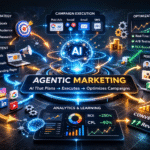
Agentic Marketing refers to the use of autonomous AI agents that can plan, execute, optimize, and scale marketing campaigns with minimal human intervention. Instead of simply analyzing data or generating content, these AI agents take goal-oriented actions—making decisions, launching campaigns, reallocating budgets, and continuously improving performance.
If you’re a business owner, marketing manager, or founder wondering how AI can actually run campaigns for you, this guide breaks it down clearly and practically.
Agentic Marketing is built on the concept of AI agents—software systems powered by advanced large language models such as GPT-4 and automation frameworks that can:
Understand objectives (e.g., increase leads by 30%)
Create a strategy
Execute marketing tasks
Monitor performance
Adjust campaigns in real time
Unlike traditional marketing automation tools, which operate on predefined rules (e.g., “if user clicks X, send email Y”), agentic systems are adaptive and decision-driven. They evaluate outcomes, learn from data, and choose the next best action.
In simple terms:
Traditional automation follows instructions. Agentic marketing systems decide what to do next.
How Agentic Marketing Differs from Traditional AI Marketing
Many businesses already use AI tools for:
Writing copy
Creating ad creatives
Email personalization
Predictive analytics
But these tools are assistive. They support marketers; they don’t independently manage the entire workflow.
Agentic Marketing, on the other hand:
Traditional AI Marketing
Agentic Marketing
Generates content
Plans and deploys campaigns
Analyzes data
Interprets and acts on data
Requires constant human oversight
Operates semi-autonomously
Executes fixed rules
Adapts strategy dynamically
For example, instead of asking AI to “write a Facebook ad,” you might tell an AI agent:
“Generate 500 qualified SaaS demo leads within 60 days under $50 CPL.”
The agent then:
Researches audience segments
Designs creative variations
Launches ads
Monitors performance
Shifts budget across platforms
Optimizes messaging
All without step-by-step instructions.
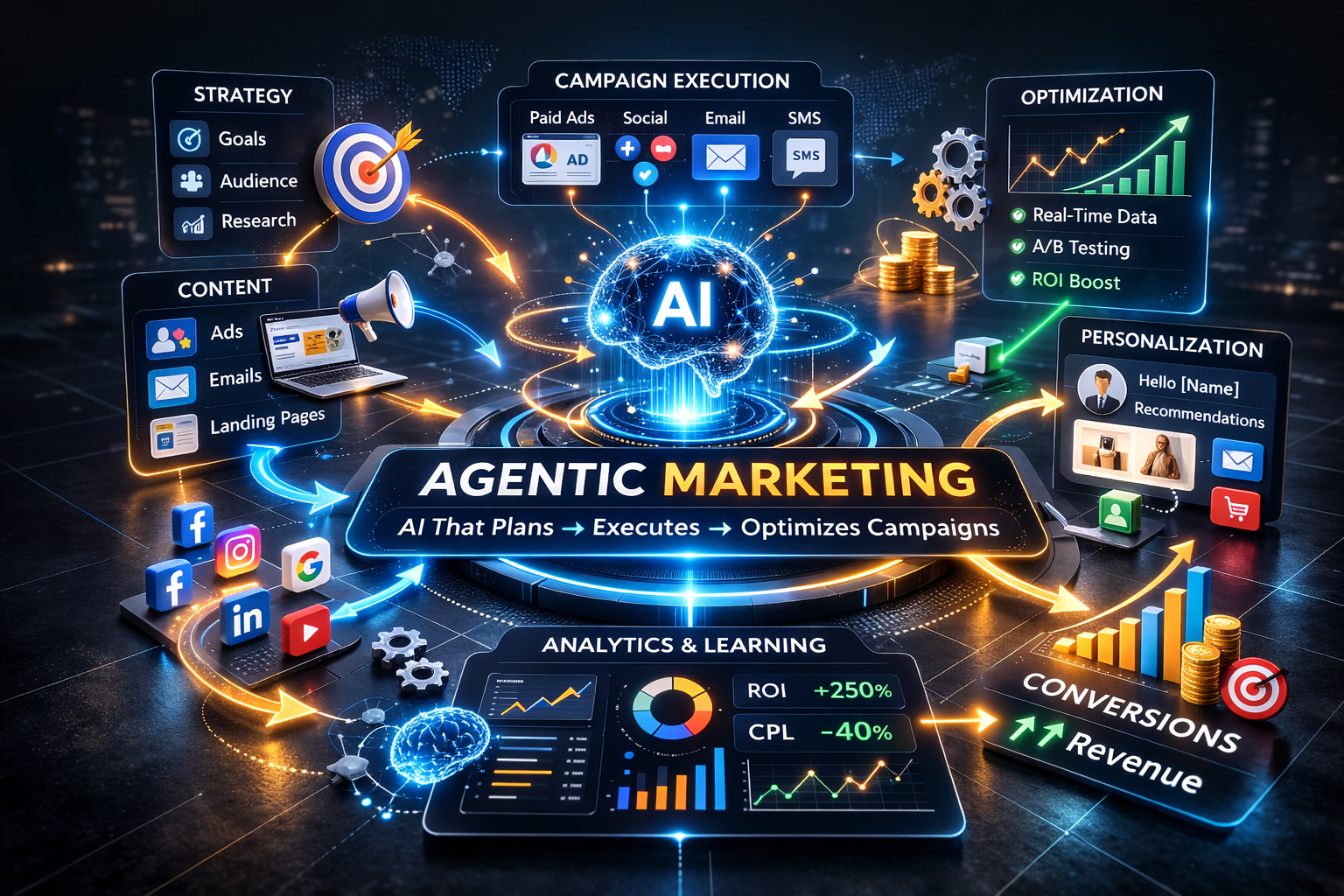
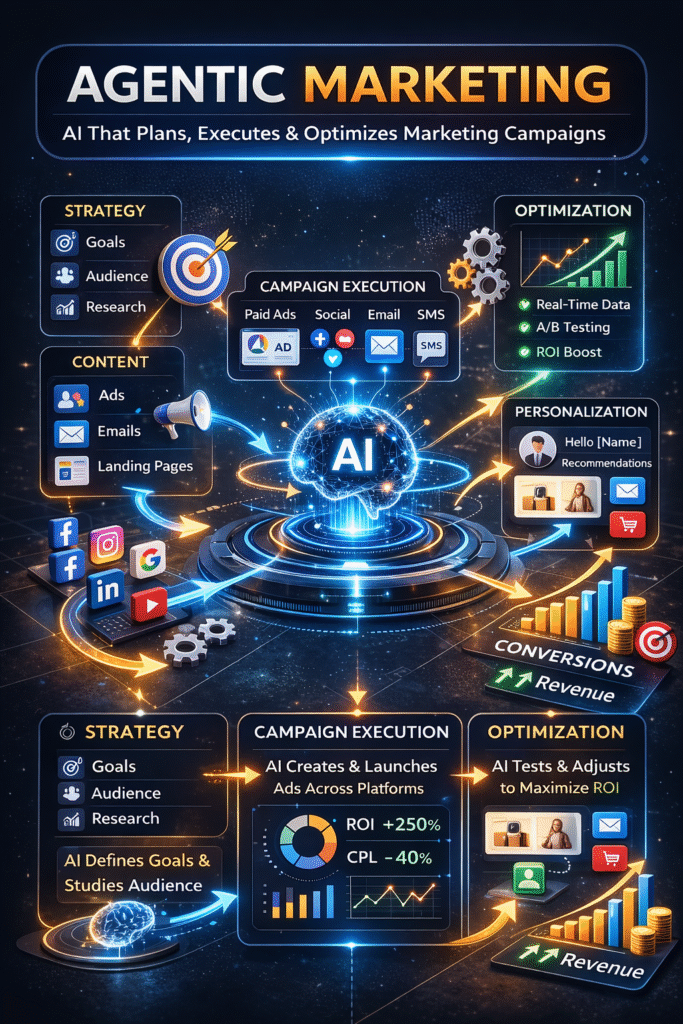
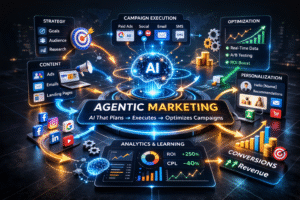
Agentic Marketing
How AI Agents Run Marketing Campaigns
Let’s walk through how AI can run campaigns from start to finish.
1. Goal Interpretation
You define high-level objectives:
Increase revenue
Improve conversion rate
Reduce churn
Scale paid acquisition
The AI agent translates these goals into measurable KPIs such as:
Cost per lead (CPL)
Customer acquisition cost (CAC)
Return on ad spend (ROAS)
Email open rate
This is strategic planning—not just execution.
2. Market & Audience Research
An AI agent can:
Analyze historical CRM data
Identify high-performing customer segments
Study competitors’ messaging
Extract insights from customer reviews
Detect emerging trends
For instance, using search and social data, the system can identify underserved niches and position your messaging accordingly.
This replaces hours of manual research.
3. Campaign Creation & Asset Generation
Using generative AI, the agent can:
Write ad copy variations
Generate email sequences
Create landing page drafts
Suggest SEO keyword clusters
Develop social media content calendars
It can also test multiple messaging angles simultaneously—pain-point driven, feature-focused, benefit-based, or urgency-based messaging.
Because it operates at scale, it can produce and test dozens of variations far faster than a human team.
4. Multi-Channel Deployment
Agentic systems integrate with platforms such as:
Google Ads
Meta Ads
LinkedIn Ads
Email platforms
CRM systems
They can automatically:
Launch campaigns
Adjust bidding strategies
Pause underperforming ads
Reallocate budget to high-converting segments
Schedule emails based on behavioral triggers
This transforms campaign management from reactive to autonomous.
5. Continuous Optimization
This is where Agentic Marketing becomes powerful.
Instead of reviewing metrics weekly, the AI agent:
Monitors performance in real time
Detects conversion drops
Identifies creative fatigue
Spots audience saturation
Tests new hypotheses
For example:
If ad CTR declines, it generates new creative angles.
If CPL rises in one geography, it reallocates budget elsewhere.
If email engagement drops, it experiments with subject lines and timing.
It essentially runs continuous A/B and multivariate testing without manual setup.
6. Learning & Strategic Evolution
Agentic systems do not just optimize tactics—they refine strategy.
Over time, they learn:
Which personas convert fastest
Which channels scale profitably
Which messaging resonates emotionally
Which offers drive repeat purchases
The result is compounding performance improvement.
Real-World Applications of Agentic Marketing
Here’s how different businesses can benefit:
SaaS Companies
Automated lead generation funnels
AI-managed LinkedIn prospecting
Dynamic onboarding email flows
E-commerce Brands
AI-optimized product ads
Abandoned cart recovery sequences
Dynamic pricing experiments
Agencies
Autonomous client campaign management
Automated reporting dashboards
Scalable content production
B2B Enterprises
Account-based marketing automation
AI-generated thought leadership
Multi-touch attribution optimization
Benefits of Agentic Marketing
1. Speed at Scale
AI agents operate 24/7 and can execute thousands of micro-adjustments daily.
2. Cost Efficiency
Reduced dependency on large marketing teams lowers operational overhead.
3. Data-Driven Precision
Decisions are based on real-time performance data—not intuition.
4. Personalization at Scale
AI agents can tailor messaging based on:
Demographics
Behavior
Purchase history
Engagement patterns
5. Reduced Human Error
Automated optimization reduces manual mistakes in campaign setup and budget management.
Challenges & Considerations
Agentic Marketing is powerful—but not plug-and-play magic.
Data Quality Matters
AI agents rely on structured, accurate data. Poor CRM hygiene can lead to flawed decisions.
Strategic Oversight Is Still Required
Humans must:
Define goals
Approve brand voice
Monitor ethical compliance
Validate long-term positioning
Ethical & Compliance Risks
Autonomous systems must follow advertising regulations and data privacy laws (e.g., GDPR, CCPA).
Without guardrails, automation can scale mistakes quickly.
The Future of Agentic Marketing
As AI models continue to advance, we’re moving toward fully autonomous growth systems.
Emerging capabilities include:
Predictive demand forecasting
Real-time competitor response modeling
AI-generated video ad creatives
Voice-based campaign management
Cross-channel attribution modeling
In the near future, marketing teams may shift from campaign operators to AI supervisors—focusing more on strategy, creative direction, and brand building.
Is Agentic Marketing Right for You?
Agentic Marketing is ideal if:
You run multi-channel campaigns
You rely heavily on paid acquisition
You want scalable lead generation
You need performance optimization at speed
You have sufficient historical data
It may not be ideal for:
Very early-stage startups with limited data
Businesses without clear marketing goals
Brands needing heavy human storytelling and experiential branding
Final Thoughts
Agentic Marketing represents a shift from AI as a tool to AI as an operator.
Instead of assisting marketers, AI agents can now:
Plan strategy
Launch campaigns
Optimize budgets
Personalize content
Improve performance continuously
For businesses focused on growth, efficiency, and competitive advantage, Agentic Marketing is not just a trend—it is a structural evolution in how marketing operates.
The companies that adopt autonomous marketing systems early will likely outpace competitors in speed, data leverage, and cost efficiency.
If you are looking to scale without proportionally increasing headcount, AI-driven agentic marketing may be your next strategic advantage.









Post Comment